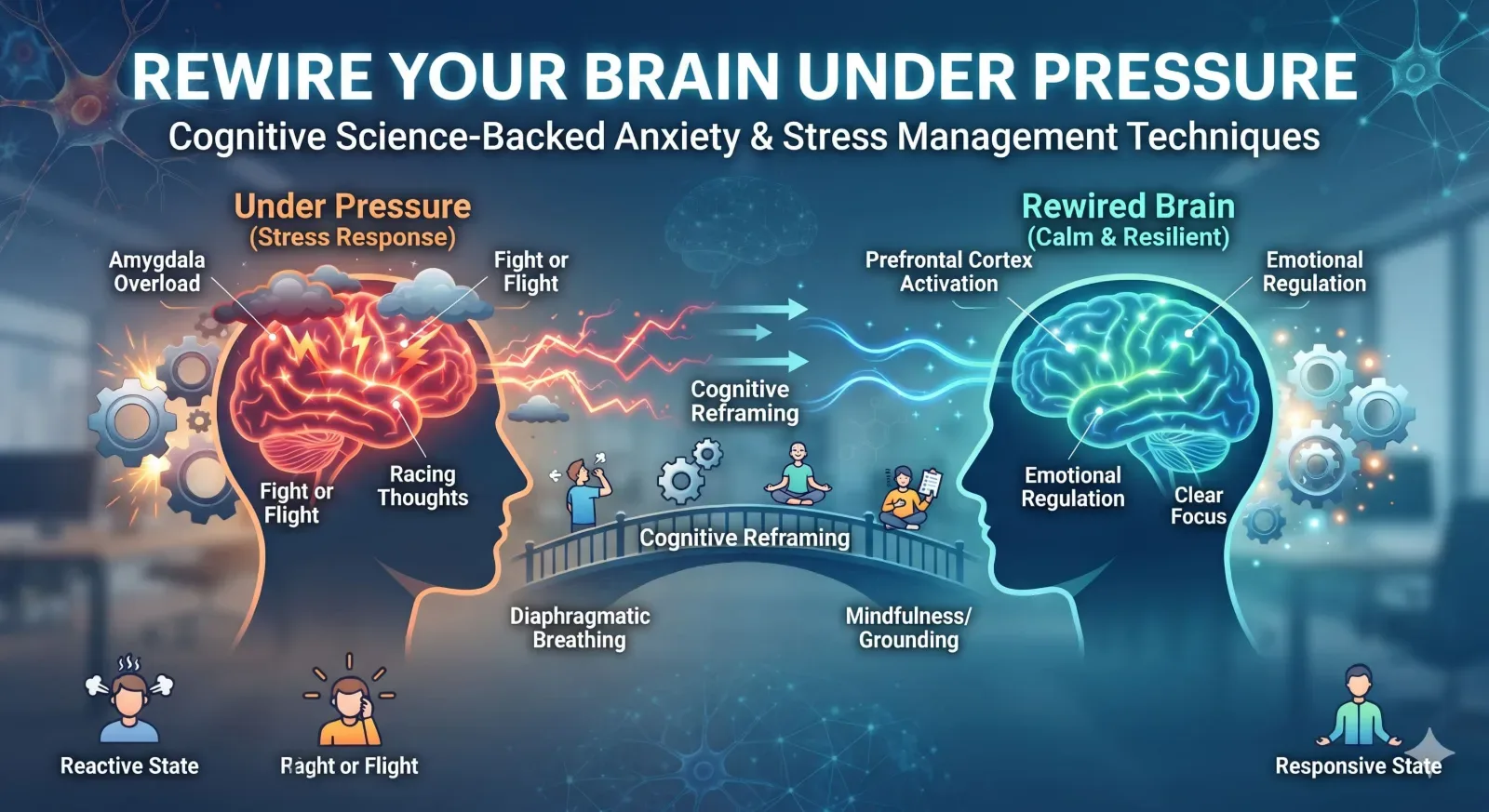
Rewire Your Brain Under Pressure: Cognitive Science-Backed Anxiety and Stress Management Techniques -
Modern workplaces demand relentless mental agility. Yet, between relentless notification pings, competing priorities, and high-stakes deliverables, the human brain often perceives the modern office as a hostile environment. When high expectations persist without recovery, acute pressure degrades into chronic distress and burnout.
To genuinely reclaim mental focus and emotional resilience, you need more than generic advice like "take a deep breath." You need protocols grounded in cognitive science. By understanding how the prefrontal cortex interacts with the autonomic nervous system, you can implement precise, high-leverage anxiety and stress management techniques that recalibrate your mental state in real time.
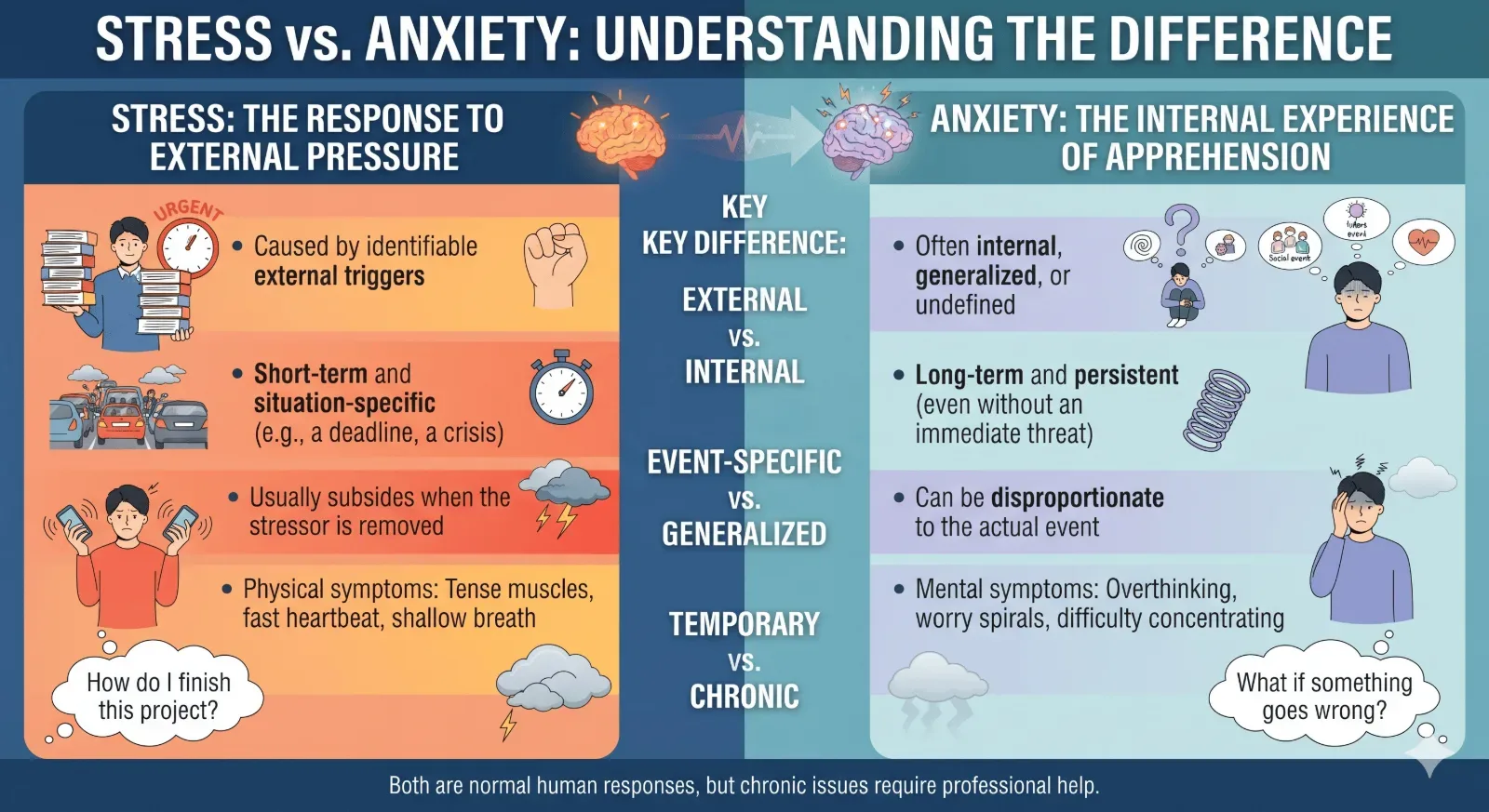
The Neural Mechanics of Anxiety vs. Stress -
From a cognitive neuroscience perspective, stress and anxiety engage distinct pathways:
• Stress is primarily a bottom-up physiological response to an immediate external challenge. Your sympathetic nervous system initiates a cascade of cortisol and epinephrine, sharpening focus to solve an identifiable, proximate problem. Once the obstacle is cleared, homeostatic balance returns.
• Anxiety is a top-down, cognitive appraisal loop. Driven by hyperactive signaling between the amygdala and the default mode network (DMN), the brain ruminates on hypothetical, future-oriented threats. The stressor is internal, abstract, and sustained by narrative rather than physical reality.
True resilience requires training both pathways: down-regulating bottom-up autonomic arousal while simultaneously restructuring top-down cognitive distortions.
4 Cognitive Science Protocols for Immediate Relief -
- Neuro-Respiratory Modulation: The Dual-Inhale Reset -
When acute anxiety spikes, the brain’s respiratory pacemaker—the pre-Bötzinger complex—accelerates. While typical "deep breaths" can inadvertently trigger hyperventilation, a deliberate physiological sigh directly stimulates the vagus nerve to slow heart rate.
• The Protocol: Take a deep, continuous nasal inhale until your lungs are roughly 80% full. Without exhaling, inhale sharply once more through the nose to fully inflate collapsed alveoli in the lung bases. Follow this with a long, unforced oral exhalation lasting twice as long as the inhale.
• The Mechanism: Two to three repetitions rapidly increase carbon dioxide tolerance and activate acetylcholine release, shutting down the sympathetic alarm state within 30 seconds.
2. Cognitive Defusion and Linguistic Distancing -
The brain naturally fuses with internal dialogue, treating subjective fears ("I am going to fail this launch") as empirical facts. Research in metacognition demonstrates that shifting internal syntax changes the neural processing of emotional valence.
• The Protocol: Shift from first-person identification to third-person objective observation. Instead of thinking "I cannot handle this workload," translate the observation to: "My brain is generating the narrative that this workload is unmanageable." Alternatively, address yourself by name silently ("Alex is experiencing a transient spike in cortisol").
• The Mechanism: This syntactic separation disengages the anterior cingulate cortex from emotional reactivity, activating the dorsolateral prefrontal cortex to assess situations with analytical detachment.
3. Exteroceptive Anchoring (Suppressing the DMN) -
Anxiety keeps attention interoceptively locked—obsessively scanning heartbeats, throat tightness, and racing thoughts. This self-referential loop is driven by the Default Mode Network. Shifting attention outward (exteroception) forcibly silences this loop.
• The Protocol: Fix your vision on a single point in the distance, then consciously expand your peripheral vision horizontally and vertically without moving your eyeballs. Take note of three visual textures and two distant, non-vocal sounds.
• The Mechanism: Broadening visual fields directly disengages the brainstem's vigilance centers, switching cognitive bandwidth from internal rumination to raw sensory processing.
4. Somatic Down-Regulation: Interrupted Clenching -
Chronic cognitive strain produces unconscious motor tone elevation, notably in the temporalis, masseter, and suboccipital muscles.
• The Protocol: Drop your tongue from the roof of your mouth, unlock your teeth, and let your jaw hang slightly slack. Simultaneously drop your shoulders an inch down away from your ears.
• The Mechanism: The trigeminal nerve carries dense bidirectional signals to the brainstem. Voluntarily releasing facial and jaw tension sends direct feedback to the locus coeruleus that the immediate environment is safe.
Evidence-Based Stress Management Techniques at Work -
High-performance corporate cultures often trigger chronic cognitive fatigue, depleting working memory and executive function. Applying targeted stress management techniques at work restores neural stamina throughout the workday:
Tactical Cognitive Offloading
Working memory capacity is strictly limited to roughly four discrete chunks of information. Attempting to hold tasks in memory keeps the brain in a state of low-grade vigilance.
• Actionable Tip: End every workday with an "Open Loop Audit." Transcribe every half-finished email, unmade decision, and looming deadline onto physical paper. Group them into binary categories: Actionable by 10 AM tomorrow versus Passive/Dependent on others. By moving tasks from working memory to an external substrate, you eliminate evening cognitive churn.
The 50-Minute Ultradian Reset -
Human mental performance operates along 90-minute ultradian rhythms, followed by a mandatory 10-to-20-minute trough in alert energy. Forcing continuous work through this trough impairs prefrontal cortex glucose metabolism.
• Actionable Tip: Cap deep work blocks at 50 minutes. Dedicate the remaining 10 minutes to deliberate, non-screen rest—such as a brief walk, physical stretches, or gaze defocusing. Staring at social media or checking messages during breaks does not qualify as cognitive rest; it merely changes the sensory source of mental load.
Pre-Meeting Cognitive Reframing -
High-stakes meetings frequently provoke anticipatory anxiety.
• Actionable Tip: Reframe your physiological arousal. The somatic sensations of anxiety (accelerated pulse, perspiration, alertness) are identical to the physiological markers of readiness and excitement. Tell yourself: "My cardiovascular system is mobilizing oxygen to deliver peak performance." This reframing preserves executive function and prevents panic-induced cognitive freezing.
Systematic Application: The Stress Management Techniques PDF Resource
Consistent behavioral application transforms intellectual knowledge into automated autonomic resilience. When cortisol levels surge, reading long articles is difficult because executive function is suppressed.
This printable worksheets serves as an on-demand neuro-reset manual, featuring:
✨ 16 Actionable Worksheets grounded in cognitive science –
• Anger Anatomy and Regulation Bundle
• Architecture and CBT Problem Solving Bundle
• Architecture of Fear and Deconstruction Bundle
• Chronic Worry Innovation Bundle
• Five Diamonds Problem Solving Worksheet
• Gratitude Cognitive Science and Reality Shift Bundle
• Guilt and Shame Architecture and Repair Bundle
• Helplessness Architecture And Reframe Bundle
• Intolerance of Uncertainty Guide
• Mindset Architecture and Detective Bundle
• Overthinking and Clarity Canvas Bundle
• Sadness Anatomy and Filter Repair Bundle
• Strength Shield Comprehensive Guide and Worksheet
• The Awe Switch Ultimate Bundle
• Weight of Choice and Decision Matrix Bundle
• Worry to Values Compass Full Bundle
💡 "Bulb-on" Breakthroughs designed by world-class psychologists.
🎯 Tools to instantly clear brain fog, calm fear, and regain control.
Cultivating Neural Plasticity -
Stress and anxiety are not personal shortcomings; they are evolutionarily conserved survival circuits misfiring in an abstract, modern world. By applying systematic, cognitive-based interventions, you train your brain to down-regulate reactivity and preserve intellectual clarity. Choose one autonomic breathing protocol and one workplace boundary to test tomorrow, and allow neuroplasticity to turn deliberate practice into calm intuition.