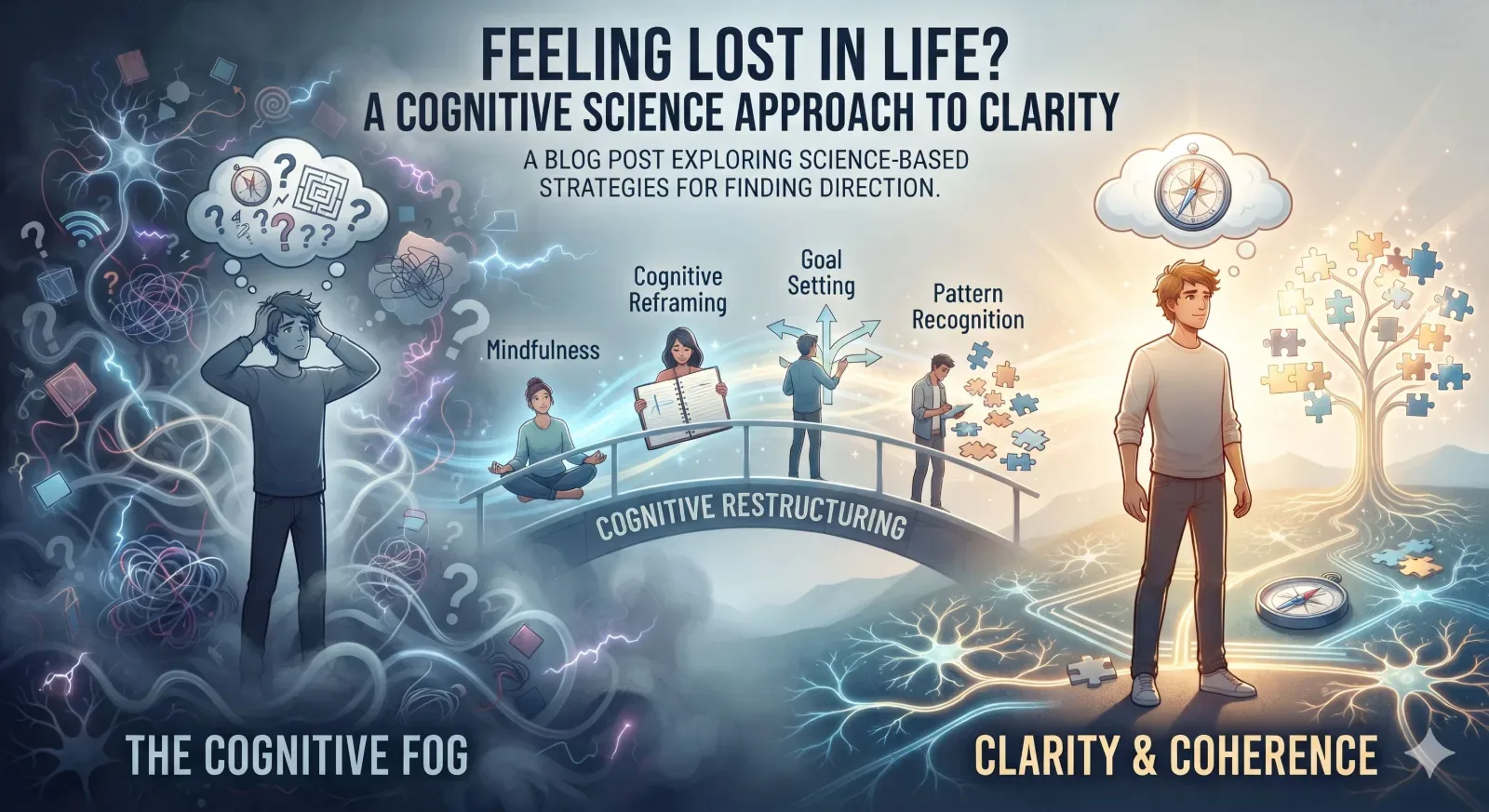
Introduction: The Silent Paralysis of 'Lostness'
You wake up, complete your routine, respond to emails, and go through the motions—yet underneath the surface lies a persistent, hollow whisper: I have no idea what I am doing with my life.
If you have recently typed "lost in life" into a search bar late at night, you are experiencing one of the most common yet intensely isolating human conditions. Society frequently misdiagnoses this sensation as laziness, a mid-life or quarter-life crisis, or a fundamental defect in ambition. Well-meaning friends advise you to "just find your passion" or "think positive," which only accelerates guilt and cognitive paralysis.
Cognitive science offers a radically different perspective: feeling lost in life is rarely a deficit of character, intelligence, or purpose. Rather, it is a predictable neurocognitive response to information overload, predictive model breakdown, and autonomic nervous system fatigue. When you understand the underlying cognitive architecture, regaining direction ceases to be an existential ordeal and becomes an empirical problem you can systematically resolve.

The Cognitive Science: Why Your Brain Feels 'Lost'
To solve the problem of feeling lost, we must inspect the mechanics of cognition. Modern cognitive psychology and computational neuroscience reveal three primary mechanisms behind this state:
- Breakdown in Predictive Processing
The brain is fundamentally a predictive engine (Friston, 2010). It constantly generates internal models of the world to forecast future events, conserve metabolic energy, and minimize uncertainty. When you undergo rapid life transitions, career burnout, or chronic environmental ambiguity, your predictive models begin to fail. The discrepancy between what your brain predicts and what reality delivers is registered neurochemically as high prediction error—experienced subjectively as disorienting anxiety, dissociation, and loss of grounding.
- Working Memory Saturation & Executive Fatigue
The prefrontal cortex manages executive functions—goal prioritization, working memory, and impulse inhibition. When open mental loops, financial anxieties, and relational uncertainties remain unresolved, they hijack working memory capacity. The brain enters cognitive thrashing: spending so much computational bandwidth switching between worries that zero cognitive margin remains for long-range strategic decision-making.
- The Cognitive Fusion Trap
In Acceptance and Commitment Training (ACT), 'cognitive fusion' describes the process where individuals treat fleeting subjective thoughts as objective, immutable realities. When an overwhelmed mind generates the narrative, "I am hopelessly behind," cognitive fusion leads you to experience that verbal construct as fact rather than a momentary byproduct of nervous system exhaustion.
"Feeling lost is not an identity or a permanent trajectory. It is your nervous system signaling that your current mental models can no longer process existing environmental demands."
— Cognitive Architecture Insight
4 Evidence-Based Solutions to Move from Inertia to Momentum
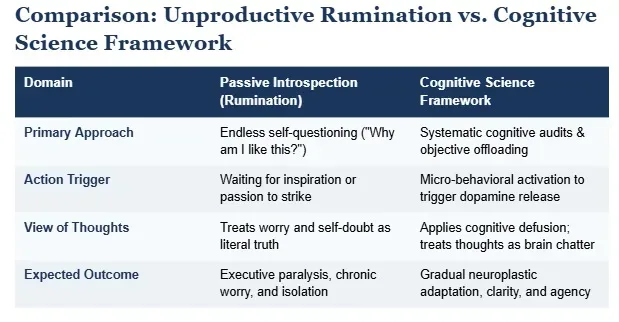
To rebuild clarity, you cannot rely solely on introspective rumination. Deliberate cognitive interventions and somatic recalibrations are required to quiet the threat-detection network and restore executive control.
Step 1: Cognitive Offloading via an Objective Brain Dump
When you feel lost in life, rumination spirals because the working memory loop is closed. Cognitive offloading—physically transferring mental representations onto external media—immediately decreases prefrontal load (Risko & Gilbert, 2016).
· The Implementation: Take a blank sheet or worksheet. Without filtering or organizing, write down every single thought, micro-obligation, existential worry, and pending decision currently circulating in your consciousness.
· The Cognitive Mechanism: By rendering internal distress into visible, spatial objects, you deactivate the amygdalar alarm system. You transform nebulous dread into discrete data points that can be systematically audited.
Step 2: Behavioral Activation (Action Precedes Motivation)
A prevalent cognitive error is believing that clarity precedes action. Neurological research confirms the reverse: dopaminergic signaling and behavioral momentum are sparked by action, not passive deliberation.
· Micro-Actions: Choose an action so micro-scale that resistance is impossible (e.g., clearing one surface, sending one inquiry, walking for 10 minutes).
· The Feedback Loop: Completing a concrete micro-behavior generates positive feedback in the striatum, mitigating dopamine depletion and restoring the felt agency needed for broader life navigation.
Step 3: Systematic Cognitive Defusion and Thought Auditing
When navigating life transitions, catastrophic self-talk accelerates existential helplessness. Utilizing structured Cognitive Behavioral (CBT) thought records allows you to dismantle automatic cognitive distortions.
· Name the Story: Instead of affirming "I am a failure with no future," deliberately frame it as: "My mind is currently producing the story that I have no future."
· Evaluate Evidence: Interrogate the thought: What objective, falsifiable evidence supports this conclusion? What contradictory data am I filtering out? What would a balanced cognitive appraisal look like?
Step 4: Re-anchoring Value Hierarchies
When individuals feel lost, they are frequently living by inherited or external success metrics rather than personal core values. Without an internal compass, external choices feel arbitrary and demotivating. Clarifying your top three non-negotiable operative values (e.g., autonomy, craft, connection) establishes a rational filter for saying 'no' to noise and re-aligning daily effort.
The Path Forward: Restructuring Your Mental Baseline
The journey out of feeling lost in life does not require an instant 10-year master plan or a sudden spiritual epiphany. It requires deliberate, daily micro-realignments. When you reduce cognitive load, challenge irrational thinking traps, and ground yourself in small, manageable routines, your prefrontal cortex naturally re-engages—and clarity inevitably returns.
Take the First Step: Restore Mental Clarity Today
If persistent worry, mental clutter, and chronic self-doubt are keeping you stuck in overwhelm, abstract advice won't be enough. You need concrete, guided cognitive tools.
Our structured, self-directed mental wellness workbooks guide you through evidence-based thought records, worry decatastrophizing, somatic regulation, and clarity frameworks designed to break the paralysis loop.
👉Click here to check out our Self-Directed Anxiety & Worry Management Worksheets
(Begin rewiring repetitive worry loops and rebuild your personal momentum from the inside out.)
Frequently Asked Questions (FAQ)
· Q: Why do I feel lost in life even when everything seems fine on paper?
A: Feeling lost often occurs when your external achievements diverge from your internal neurological value system, or when chronic cognitive load exhausts your executive function without your conscious awareness.
· Q: Is feeling lost a sign of clinical depression or an anxiety disorder?
A: While persistent feelings of detachment or hopelessness can overlap with depressive and anxiety states, feeling lost is frequently an adaptive pause signal from the nervous system indicating cognitive burnout or environmental misalignment. If symptoms severely impair daily functioning, consulting a licensed mental health professional is strongly recommended.
· Q: How long does it typically take to regain clarity?
A: Neuroplastic shifts and behavioral momentum begin within days of applying structured cognitive offloading and micro-activation routines. Deeper life direction typically crystallizes over 4 to 8 weeks of consistent behavioral experimentation.